
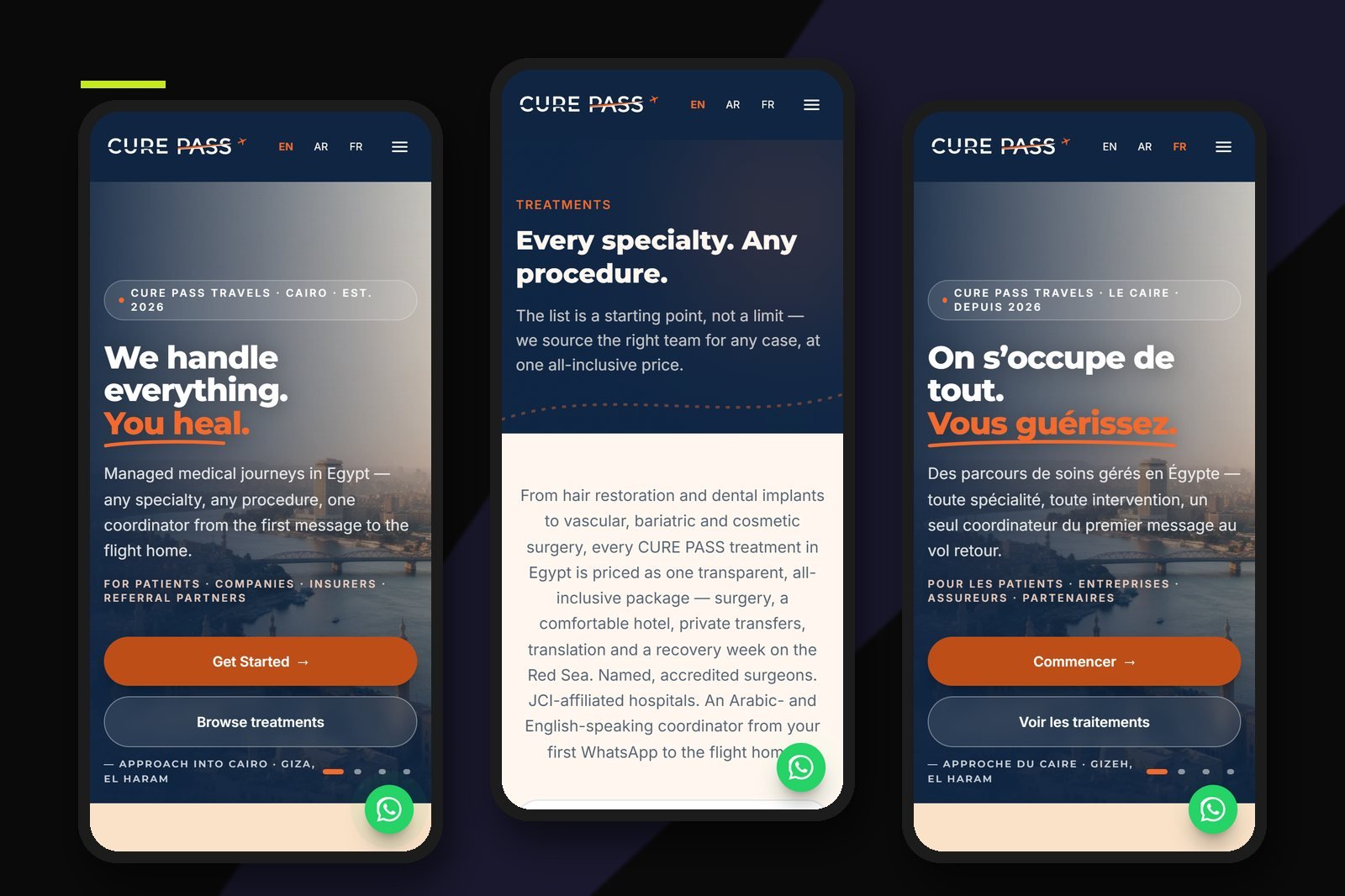
An international patient decides whether to message a medical tourism provider by asking four questions: can I trust these doctors, what exactly will it cost, what will the trip involve, and who will look after me before, during and after? A medical tourism website has to answer all four in the patient's own language, before the first message, with names, prices and a clear plan rather than promises.
We built Cure Pass Travels, a medical travel company bringing patients to Egypt, and this article draws on that build. It is our most demanding website, and it shows how much a medical tourism site has to carry.
Why medical tourism sites are different
A local clinic's patient can drive past the building, ask a neighbour and visit for a consultation. A medical traveller cannot. They are anxious, comparing several countries and providers, often reading in their second language, and deciding whether to spend a large sum and get on a plane. Every gap on the website becomes a reason to choose someone else.
The plan and the price before travel
The question patients ask most is "how much will it cost in total?". Cure Pass answers it on the treatments page itself: each treatment is described as one all-inclusive package covering the procedure, the hotel, private transfers, translation and a recovery period. Whatever your offer, say clearly what is included and what is not, and how the final price is confirmed after the patient's reports are reviewed.
Named doctors and accredited care
Patients want to know exactly who will treat them and where. Show each doctor by name, with a real photo, specialty, qualifications and languages, and name the hospitals or care centres with any accreditation they hold. Cure Pass has a page for each doctor and each care centre, linked to the treatments they provide, so a patient can follow the path from a procedure to the surgeon to the hospital.
The trip itself
Medical travel is travel. Patients need to know where they will stay, how they get from the airport to the hospital, how long they should plan to stay, and what recovery looks like. Destination pages, a clear step-by-step journey and honest timelines answer the questions that otherwise arrive as twenty separate messages.
Their language
International patients read in their own language, and often search in it. Cure Pass runs in English, Arabic and French, with about 100 pages in English, 92 in Arabic and 90 in French, each written for its readers and linked to its versions in the other languages. Choose languages from where your patients actually come from, and write each one natively; a machine-translated page about surgery does not build trust.
More than one audience
Medical tourism often serves several audiences at once. Cure Pass has paths for patients, for companies sending employees, for insurers and for referral partners, each with its own questions. A single generic page cannot answer them all; give each audience its own entry point.
Aftercare and a single contact
Patients worry most about what happens after they fly home. Explain the follow-up plan, how they reach the doctor after returning, and what happens if something goes wrong. Cure Pass promises one coordinator from the first message to the flight home, and the site makes that coordinator reachable on WhatsApp from every page. A named, reachable person is one of the strongest trust signals a medical tourism site can offer.
Trust and the rules
Patient stories and before-and-after photos are persuasive, but they need the patient's written consent, and some markets restrict them in health advertising. Avoid superlatives and promised results; say what you do, with names and facts. Advertising platforms also review medical and cosmetic offers closely, so the site's claims should be ones you can substantiate.
Being found and recommended
International patients search in several languages and increasingly ask AI assistants where to go for treatment. Treatment pages written for each language, each page linked to its versions, the organisation and its treatments described in structured data, and AI search crawlers allowed in the robots file give a medical tourism site its chance to appear in those answers. Cure Pass is built this way.
A checklist for a medical tourism website
- A page per treatment with what is included in the price and how the final price is confirmed.
- Named doctors with real photos, qualifications and languages.
- Named hospitals or care centres and their accreditation.
- The journey step by step: arrival, stay, procedure, recovery, return.
- Every language your patients use, written natively and linked.
- Separate entry points for patients, companies, insurers and partners if you serve them.
- Aftercare explained, and one named contact reachable on WhatsApp.
- Patient stories only with written consent; no superlatives or guarantees.
In short
Answer the four questions before the first message: who will treat me, what will it cost, what will the trip involve and who will look after me. That is what we built into Cure Pass Travels; see Medical Website Design for how we build medical sites, and our complete guide for planning one.
Questions
What should a medical tourism website include?
Treatment pages with clear all-inclusive pricing, named doctors and hospitals with their credentials, the journey step by step, every language your patients use, separate paths for each audience, aftercare details and one named contact reachable on WhatsApp.
Should a medical tourism website show prices?
Yes, as clearly as you can: what each package includes and how the final price is confirmed after the patient's reports are reviewed. Price is the question international patients ask most.
Which languages does a medical tourism website need?
The languages your patients actually use. Write each one natively and link each page to its versions in the other languages so search engines show the right one.
Can a medical tourism website show patient stories?
Only with the patient's written consent, and within the rules of the markets you advertise in, some of which restrict testimonials in health advertising.